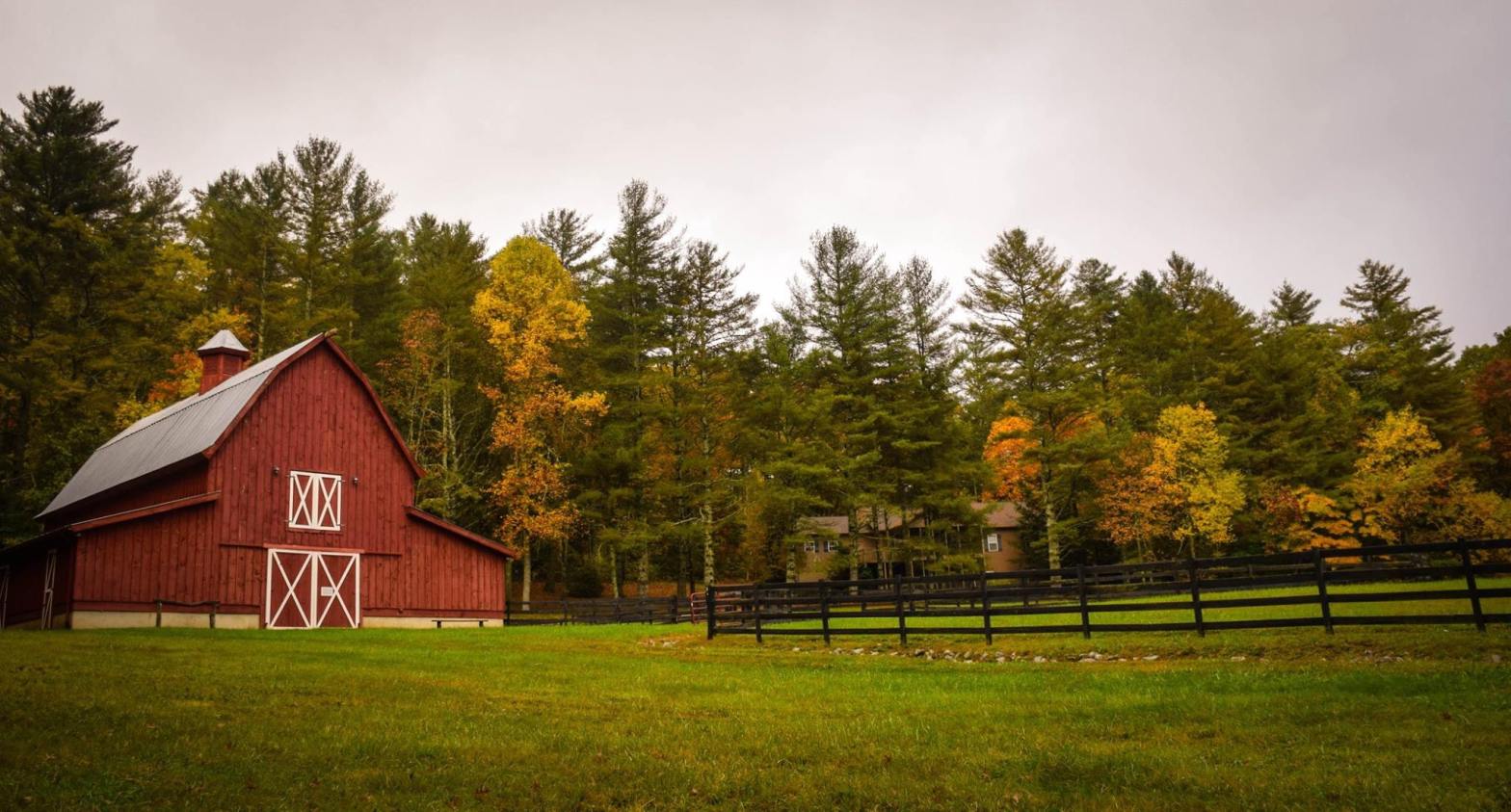
‘You see that very green field over there?’ she says, pointing at it with her finger. ‘I hate to point the finger, but that’s my neighbour’s field. It’s just rye grass, which makes it look a lovely colour, but it doesn’t support an insect population, which means the songbirds have nothing to eat.’
It is August 2021, and my housemates and I are camping in a field on an organic farm in Monmouthshire which one of us found on Airbnb, of all places. The holiday is quaint, but intensely relaxing. We let our host talk us into a tour of the farm she manages. Her 8-year-old daughter runs us, from memory, through the different flowers in the hay meadows and pauses occasionally to draw our attention to the song of a particular bird.
‘I sometimes wonder,’ she (the mother) says a little later on, ‘why everybody doesn’t farm like this.’ Like this means letting all kinds of flowering weeds grow in the hay meadows, big unmanaged ‘margins’ in the other fields, no pesticides, composting privies, pride in the abundance of insects and songbirds, and flagrant disregard for the apparent local custom of keeping farms ‘tidy’ – square, bounded by hedges, and run on strict crop rotations. After she is gone, I wonder aloud whether the rarity of her method has a common ancestor with the shiny new car by the farmhouse and the recent and extensive refurbishment to the latter. Maybe I am being harsh on her; maybe she is being harsh on the other farmers along the Usk.
Later in our trip we buy some firewood from her (from the woods around the farm) as well as a pack of burgers which in a former life used to graze the same meadows where we earlier stooped to observe insects swarming on the chickweed flowers. We cook them on an iron grate over a fire painstakingly lit in the corner of the field in spite of the best efforts of the wind. The pleasing local-ness of the meat clashes awkwardly with the brioche buns and burger relish from the big Sainsbury’s in Bridgend, but these prosaic elements don’t distract from the goodness of the beef, and we all enjoy its tender subtlety. Cynically I joke that I can almost taste the birdsong.
Apart from telling this story a few times for laughs, I haven’t really thought about that farm or those methods in the 10 or so months since. This afternoon, reading a collection of Wendell Berry essays under a sweet chestnut tree in Christ Church Meadow, I remembered it all with a jolt. Berry is a radical critic of the modern economy – and particularly the modern American economy – which he sees as driven essentially by waste, and decries its contribution to the much-lamented loss of human rootedness common to virtually all civilisations in the last century or so. His resistance to this destruction is private as well as public – some years ago he abandoned the pursuit of a writing career in New York City to tend to a farm in a forsaken corner of Kentucky which has been home to his family for generations. There, the blurb of my copy of his book says, he ‘lives and works in the old ways’.
Crass as it sounds, Russia’s unprovoked invasion of Ukraine is causing disruption to trade in food around Europe and elsewhere in the world, and the conversation about food sufficiency is becoming current again after a fair few years in the dustbin of ‘primitive’ economics. Presciently, Berry worries that an import/export economy relies on cheap long-distance transport, which ‘is possible only if granted cheap fuel, international peace, control of terrorism, prevention of sabotage, and the solvency of the international economy.’ One wonders whether history in the long term will prove any more merciful and pro-social than Vladimir Putin.
We would do well to take the opportunity to consider whether the consumerism which has led to this precarious situation is worth the dangers it has caused. Berry would like to see a return to ‘[f]arming by the measure of nature, which is to say the nature of the particular place’, such that ‘farmers must tend farms that they know and love, farms small enough to know and love, using tools and methods that they know and love, in the company of neighbors [sic] they know and love.’ Not much love may be lost between my one-time host and her neighbours, but as I watch the insects buzzing between different flowers strewn in the meadow around me, I can’t help but think that she, like Berry, has a point.
Image by Frances Gunn on Unsplash
 Yikeiatry