Neither Here nor There

Driving from my parents’ home to mine takes me from a region known in Thomas Hardy novels as ‘Outer Wessex’ in the extreme west to one that is too far east to appear on his map. This distance which encompasses the entire landscape of 14 novels takes me a mere 2 and a quarter hours. Every time I make the journey I think of Tess Durbeyfield driving a horse-drawn wagon through the night to reach the nearest market town by morning. The comparison is stark: in a modern car the journey is a matter of minutes, and Tess’s eyes would boggle at the idea of travelling all the way across the map without stopping. By any rational reckoning, this change is a remarkable opening of possibilities – a progress of human frontiers for which we must be grateful.

Wendell Berry describes the modern person as a truncated Prodigal, stuck in the wild living of the far distant country and with our return home blocked by norms, expectations, and professional convenience. (Spiritually, of course, our return isn’t blocked: wonderfully, the Father rushes to greet the modern Surrey professional with all the abandon and extravagance he poured out on the 1st century Judaean yeoman.) But in material terms even this bleak picture doesn’t do the situation justice. The distant country, too, is transitory and full of merely shallow relation to place. Apparently my road is known to locals as ‘Jimmy Street’. When I read this fact in a book about local place names (I know, I know), it struck me I’d never heard the name. Most of the people I know here aren’t ‘local’, either. I am not just stuck in the wrong place (that would be easily rectifiable); I cannot see how I could belong in a place at all.

Of course there are communities – religious, professional, social – to which a person can choose to belong, and by God’s grace I know some of that joy here. I am nevertheless haunted by the story in the introduction to David Goodhart’s The Road to Somewhere of the man known to those in his neighbourhood in East London as ‘the Sherriff’ for the longevity and earnestness of his local influence. Poignantly, his new neighbours don’t know that the street they live on is ‘his’, or even that he has the nickname, much less why. It haunts me because I recognise it: the only people on my street I know by name are either colleagues or immediate neighbours, and I know the latter only very superficially. In long historical perspective this lack of connectedness with and reliance upon the people I live around seems a dangerous and highly novel experiment. I wonder whether the results will vindicate it. Goodhart notices that people who live in this new way have distinctive political beliefs and voting patterns: we are Anywheres, while those who have grown up with a more meaningful connection to a particular place with its particular interests are Somewheres.

When people ask where I’m from (still, interestingly, a stock-in-trade small talk question for modern British Anywheres, despite how little it shapes the way we live our lives), I like to play, foolishly, to Hardy’s Wessex. I’m ‘from Somerset’, I say something about village cricket or hedgerows or real cider, I show that I can do ‘the’ accent. Apart from an idle interest in the fortunes of Bath Rugby and an affection for Butcombe beer, I’ve little claim to use that as an identity marker. There’s no dialect in my home village and few I knew there had a regional accent. Goodhart again: being a graduate of a residential university outside my hometown, I have naturally lost touch with most hometown people. Without realising how or when or that I was choosing this, I’ve become an Anywhere who isn’t from Somerset in any meaningful sense. I happened to grow up in a village full of affluent Anywheres called Monkton Combe, which is near Bath but might just as well have been put next to Cheltenham, or Blandford Forum, or York. Now that I’m one of them, the Anywhere tribe is difficult to escape: my profession and cultural instincts forbid it even if the Somewheres in any possible chosen community did accept me as one of their own.

The Wessex novels are exaggeratedly nostalgic: I assume that Hardy saw little in his Dorchester of milkmaids loading their belongings onto carts on Lady Day, of Skimmington effigies carried by furtive townspeople, or of old women selling ‘furmity’ laced with rum in festival tents. Reading them as a 21st Century nostalgic is like looking at a painting of a painting: if there was a real object there for depiction, its shape is now twice distorted. But Hardy’s nostalgia needn’t invalidate mine. Perhaps what it shows is that a reverence for generational community, and a sense of loss at its absence, is more than a cultural moment for Gen Z or idiosyncratic frustration of mine.

It is idiosyncratic and may be indulgent to have written 900 words mourning this loss when so many have lost so much more. That doesn’t mean it’s not worth thinking about. Connectedness is the price we have collectively paid for mere access. I’m not sure society has benefited from this trade, and I wish we’d kept the receipt. Resistance to the new pattern starts small and may seem futile, but I think I’d like to try.

On not knowing the songs

Blessed assurance, Jesus is mine
Oh, what a foretaste of glory divine
Heir of salvation, purchase of God
Born of his Spirit, washed in His blood

This is my story, this is my song
Praising my Savior all the day long
This is my story, this is my song
Praising my Savior all the day long

I didn’t know this song when I stood in the congregation at my church to sing it the first time early last summer. Congregational singing of an unfamiliar melody is always something I find frustrating. I like to sing expressively in church, and that’s very difficult when you don’t know the tune! I don’t quite have the exuberant self-forgetfulness to try with gusto, so usually I favour an uncertain mumble that drags behind the beat. It’s usually worth a go even just for the sake of the words. These are a splendid example: a glorious and evocative celebration of assurance, the certainty that Christian blessings apply to the singer. Familiar biblical metaphors (heir, purchase, rebirth, washing) are claimed as identity markers, leading into a triumphant refrain: this is not just a possibility for humanity, this is my story and my song. In confident and joyful knowledge of this, I praise my Saviour.

That drizzly Sunday morning, I didn’t feel triumph, or confidence, or joy. Careworn, guilty, and discouraged, I felt unable to join in the congregation’s singing. My heart joined my head, saying with sadness, ‘I don’t know this song.’ My story? My song? Whispered voices in my head poured scorn on the idea.

In the halcyon days when my club, Reading FC, played in the Championship, I went to see them play at QPR. Forced by circumstances to sit in the home end with home fans, I endured a humiliating 4-0 defeat. Even the shame of hearing 15,000 west Londoners around me gleefully singing “4-0 on your big day out” little compares to the dizzying loneliness of standing amidst 80 or so members of my spiritual family singing a song I felt unable to claim.

Some time later we sang the song again, and my heart drooped to see those marvellous lyrics projected onto the screen yards and yards away. They still seemed well out of my reach. But as the music started, I now knew the tune. I could now, even if at a superficial level, sing along with the brothers and sisters standing around me. As I sang, a rising instinct in me defied those internal voices: I might not feel it all the time, but this is my story. It is my song. If I am not feeling blessed assurance, the solution is not to lie low until I do. It’s to sing, confident of what the Lord has done, until my heart resounds with the truths in the words. How do you learn an unfamiliar song? By singing it. A holy defiance, a putting down of the foot: ‘Though the fig tree does not bud and there are no grapes on the vines, though the olive crop fails and the fields produce no food, though there are no sheep in the pen and no cattle in the stalls, yet I will rejoice in the LORD.’

What mood prompted the Psalmist to write, ‘praise the LORD, O my soul, and forget not all his benefits’? When St Paul links ‘gratitude in [our] hearts to God’ with the singing of ‘psalms, hymns, and spiritual songs’, which way does the causal channel run? Must Charles Wesley excite in himself some special spiritual fervour before he can earnestly wish for a thousand tongues with which to sing his dear Redeemer’s praise? If the gospel is true, it is true at all times. If there are benefits for me in heaven’s store, they never perish, spoil, or fade. Whatever my mood, however well I know the song, it is my story and it is my song.

Cloying embarrassment and disconnected frustration are poor medication for a downhearted Christian. The Lord Jesus is a doctor to the sick, a friend to the outcast. His gospel is food to the hungry and life to the dead. Would the same Lord reserve the joy of singing for the happy and the contented and the certain? Never, never, never.

When I don’t know the songs, then I must sing.

Photo by Chr Appelsved on Unsplash

Discovering the counties

Holidaying in various areas of the north of England this summer I realised how much of the country of my birth is just not at all familiar to me. Though I’ve lived here for 24 years in 6 different places, there’s so much here I’ve never seen. This isn’t quite a problem, but I do think it’s a shame. I’d like to put that right. The only real way to get to know a place is to live and work there, but a more realistic challenge is to travel over sections of it by foot. That’s why over the next two years I will be attempting to run at least 10k in each of England’s 48 ceremonial counties. That’s about one county on average every two weeks.

Here are some arbitrary but somewhat thoughtful rules I’ve set for myself to make this work well:

  1. No familiar routes. I’m not a very experienced runner but I could tick off about 12 counties right now where I have previously run or walked about this distance. This challenge is about discovery as much as fitness, so I’m maximising the discovery element!
  2. Self-contained. Each route must start in the appropriate county, finish there, and not leave that county’s borders. This sounds obvious but will be difficult for City of London!
  3. AONBs, National Parks, and coasts. Where possible, if a county has one of the above I will plan a route that goes through or along it. Where there are multiple, I will try to maximise coverage.
  4. Overnight stays. Where possible, I will stay in the county where I am running either the night before, the night after, or preferably both. I hope thereby to see more of England! Additionally, I am forbidding myself from booking hotel or similar accommodation. Where I don’t have friends or family willing to put me up, I must camp.
  5. Time limits. The challenge starts on 1st September 2023 and I aim to complete it by 31st August 2025. I am, though, ‘a mist that appears for a little while and then vanishes.’ So we’ll see…
  6. Strava. As a matter of historical record, I will be uploading all the runs to Strava. If my watch runs out of battery, or the length of the run falls just short, tough…

FAQs:

Why ceremonial counties?

The historic counties are a bit fuzzier. More importantly, there are fewer of them! My way there are 4 Yorkshires, a separate island, and many more urban routes.

Why 10k?

I’m not a very good runner. Additionally, the nature of my job means I will need to do most of these during school holidays, and will probably be looking to tick off multiple counties in one trip. Back-to-back half marathons or marathons are way beyond me, but a couple of 10k runs compressed into a week or so sounds a bit more feasible…

Do I want any support?

This is purely self-indulgent and not for charity or anything. Having said that, under rule 4 above, I am looking for overnight accommodation at some point in the next 2 years in every English county. If you live in one and have a few square feet of floor space you wouldn’t mind my using, drop me a line! I’d love to come and see you.

Why am I posting about this?

I’m not entirely sure. See FAQ 3 above. I also hope to inspire people to see more of our beautiful land. Perhaps the pressure of having committed publicly to this will help me over the line. Maybe you, dear reader, have some useful input about how I should do this. Let me know if so!

On being dark and cold

How shall I sing that Majesty, which angels do admire?

Let dust in dust and silence lie; Sing, Sing, ye heavenly choir!

Thousands of thousands stand around Thy throne, O God most high;

Ten thousand times ten thousand sound Thy praise, but who am I?

For many Christians, Lent begins with the words ‘remember you are dust, and to dust you shall return.’ It sounds, and quite possibly is, morbid and dark: I, like Adam, am formed of the dust of the earth, and to it this mortal body will return with terrible finality. There is something deeply uncomfortable to this realisation and in our culture it is proper neither to dwell on this certainty nor to remind others of it. Perhaps this quaint tradition, in all its confident pessimism, will itself die a death, the phrase gathering dust and bookworms with the rest of the liturgy, in rotting sheds and neglected archives.

‘Ashed’ recently for the first time, a friend wrote of the ‘ugly smear on [his] soul’ that is ‘indelibly there’. For him this improper, uncomfortable realisation has been a teachable moment: still like me in his early 20s, those words are for him too. Montaigne thought to philosophise was to learn to die. Perhaps the same is true of being catechised. How shall I sing knows this: the words invite the congregation to ‘let dust in dust and silence lie.’ Death is many things and one of them is silence; I had better learn to start being silent at least occasionally. It is not dust’s to boast arrogantly: ‘God is in heaven but you are on the earth: therefore let your words be few’.

In keeping this silence, we mortal children are better able to hear the song of the heavenly choir. In the bewildering multitude of those who are God’s, at first I can lose myself for the massed thousands, or, like Zacchaeus, feel I don’t rightly belong there. But as in Psalm 8, the ‘who am I?’ here needn’t land so much in frustrated anonymity as in stupefied awe: who am I, that my praise makes the slightest difference to Him whom millions of angels admire? A life of praise, transformed by God’s renewing, is ‘holy and pleasing to Him’.

Thy brightness unto them appears, whilst I Thy footsteps trace;

A sound of God comes to my ears: but they behold Thy face!

They sing because Thou art their sun; Lord, send a beam on me,

For where heav’n is but once begun, there Alleluias be.

One of the beautiful things of which Lent reminds us is that there is more to come for the Christian. That He reveals His character in His word, His world, and supremely by His Son is a great gift. But still the sun is my sun, not yet outshone by His glory. So often my experience in this life feels like that of the beloved in Song of Songs: ‘All night long in my bed I looked for the one my heart loves: I looked for him but did not find him.’ His sound comes to my ears; I trace his footsteps like a bloodhound. All the while I envy the angels and the saints above – for they behold His face!

But another beautiful Lenten thing is that there is much for the Christian now. Scripture doesn’t hesitate to hold these things together: ‘the Lord is my portion; therefore I will wait for Him’; ‘though you do not see him now, you… are filled with an inexpressible and glorious joy’. The sound of God in my ears is an occasion of great joy, which is for now ‘inexpressible’. There is blessing in the longing and the looking. We remember that at Advent too, but in Lent as we trace His footsteps through the desert and the parched land, we draw comfort in the confidence that it will burst into blossom like the crocus. We fast because of the feast. For now, I wonder how to sing: the answer will be ‘Alleluia’.

Enlighten with faith’s light my heart; inflame it with love’s fire.

Then shall I sing, and bear a part with the celestial choir!

I shall, I fear, be dark and cold with all my fire and light,

Yet when Thou dost accept their gold, Lord, treasure up my mite.

The poet, and the singer like him, realises that over 3 verses he has been answering his own question. ‘How shall I sing that Majesty?’ The question is a possible answer. Looking back in wonder at the first verses of the hymn, the singer sees at last a mite that he has deposited in God’s treasury. How shall I sing that Majesty? Like that!

Contemplating God’s character – His Majesty – drives me away from my own fire and light. So does Lent and so does silence. This is a good thing. My fire and light is dark and cold; my fasting and silence burns with love’s fire.

How great a being, Lord, is Thine, which doth all beings keep;

Thy knowledge is the only line to sound a depth so deep.

Thou art a sea without a shore, a sun without a sphere;

Thy time is now and evermore: Thy place is everywhere.

John Mason, 1646-94

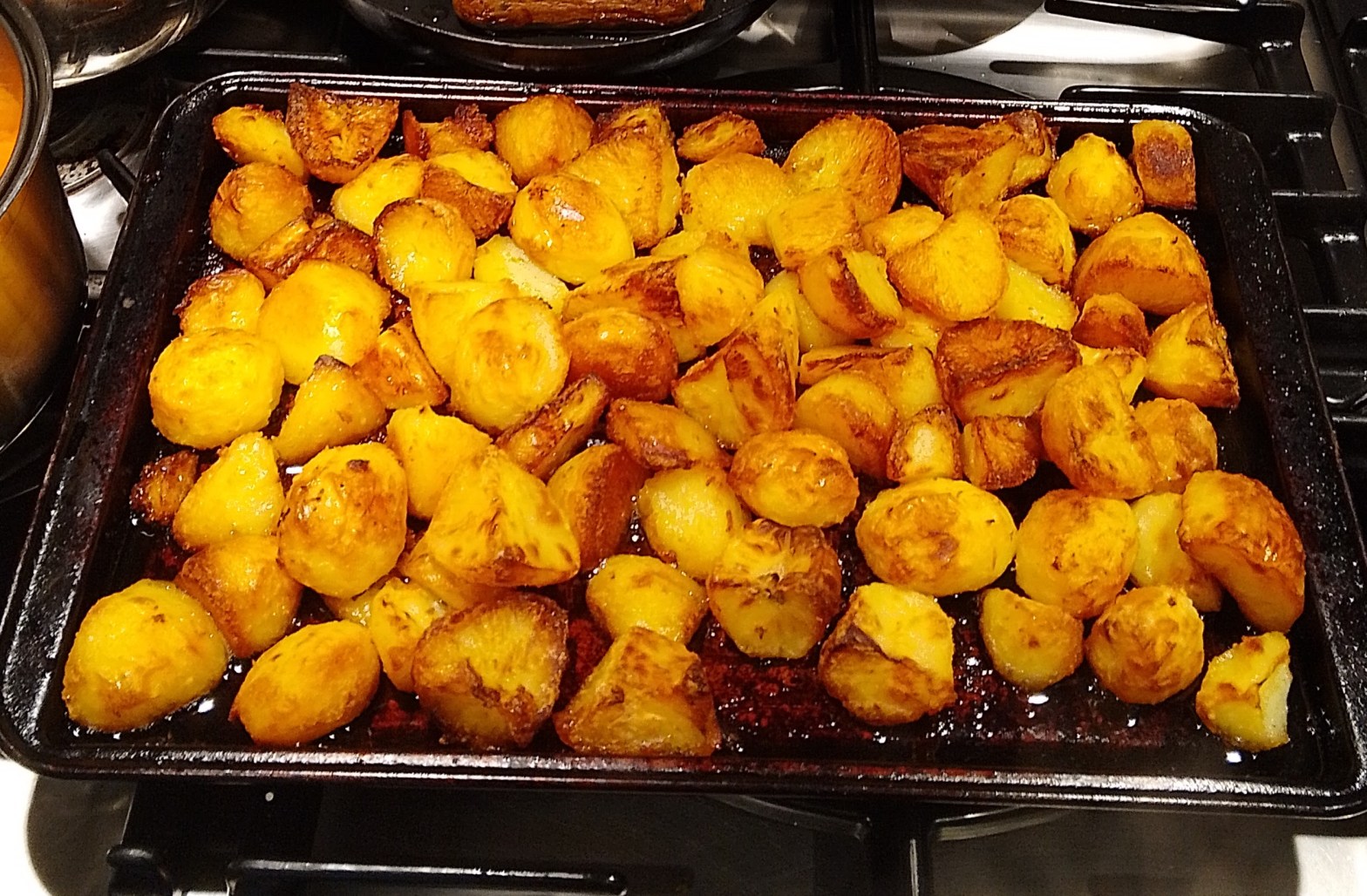
We are not worthy of the potato

This feast it is a battle which we wage against the night;

This joy is just a shadow of the resurrection life.

– Andrew Peterson, ‘Remember and proclaim’

Whether you eat or drink or whatever you do, do it all for the glory of God.

– 1 Corinthians 10:31

A few months ago I began the practice of thanking God for each ingredient I was using before I cooked with it. I never made this a rule, as if absently adding milk to my tea were an occasion for self-flagellation. Rather, I think that to be thankful to the Lord in general – to be ‘overflowing with thanksgiving’ – it is necessary to thank Him in the particular too. I want to be thankful, so practising this thankfulness seems good. The breadth of the prayer of General Thanksgiving, which I love (‘all the blessings of this life’), is not useful on its own: it is shorthand. In zooming out to the wood, we mustn’t forget the trees.

Principled living is good, but it would be foolish to drown the kitchen in legalism. In the current rhythm of my life, cooking is a moment of simplicity and peace which is a real means of grace to me: it feeds me twice. I cook simple things – mashed potato, parsnip soup, pasta with onions and bacon – and my hungry stomach doesn’t despise them. In those moments I am as far as I can get from emails, meetings, and marking: it’s just me, the food, and the Lord.

When I get the opportunity to speak of God’s goodness in public, I often reach for foods to illustrate it: Christmas dinner, porridge, and sour cream and onion pringles are just a few recent examples. Partly this is an attempt to find common ground, but it also expresses something that is deeply true: food is a beautiful and gracious gift from a supremely imaginative and generous Giver. In this respect it is an excellent theology teacher. No surprise then that Scripture is full of food: the garden full of trees that were pleasing to the eye and good for food, the hasty unleavened bread and the slow manna in the desert, the honey in the lion’s carcass, the widow’s bottomless oil and flour, the banqueting hall under a banner of love (refresh me with raisins and apples!), the best of meats and the finest of wine at that great feast, the meals with tax collectors and sinners, the five loaves and two fishes, the daily bread; finally the very flesh and blood of Christ. Food is an intense, fleshly picture of God’s sustaining grace – no wonder we speak of existential ‘hunger’. ‘I’m full,’ we say when we’ve eaten enough. In the short term, we’re right.

Tim Keller writes in Every Good Endeavour that for most of us, work is the primary way we can love our neighbour. Moreover, in others’ work, we can see how they have been instruments of God’s grace and love to us. I owe every mouthful of mashed potato to farmers, distributors, lorry drivers, shelf-stackers, and a virtually innumerable chain of workers in all kinds of industries. My gratitude could end with the free-market mechanism, or the advancing frontiers of agricultural science, or my skills in food preparation(!), but I can also relate all these things to the ingenuity and grace of the one by and for whom all things were created. I wonder more at the Cross than at the dinner plate, but my wondering at the dinner plate is real and true just the same. I can trace the busy finger of Providence in the events that led to my being a Christian in the first place; the same finger feeds me those late evenings when dinner at 5:45 is a distant and tantalising memory.

Evil human schemes and the groaning pains of creation taint food as much as anything else. Shamefully mistreated meat animals, forests devastated for mass-produced palm oil, marginal communities deprived of their staples so they can be sold to western consumers in our fickle faddishness, famine and food poverty worsened by inefficient and corrupt human organisation, ‘beauty’ standards and cultural mores that drive to despair and make grace into misery – all these things (and more) rightly incite our anger. They should make us examine our own participation in these evils, and strive to overcome them. When the Psalmist says, ‘my tears have been my food day and night,’ the implied famine is as tragic as the weeping. But all these will pass. Ours is to wage battle against the night, and to anticipate as we do so the heavenly feast unspoilt by cruelty, greed, famine, impermanence, anxiety, allergy, or shame. Like Mephibosheth, Christians will dine at the King’s table out of an overflow of his kindness. Every earthly meal is a mere foretaste.

Food teaches God’s goodness, it mediates His grace, and it shadows His glorious promises. We are not worthy of it – even in its simplest, dullest forms.

The path less travelled by

There is a genre of book of which I am particularly fond. Anyone who knows me well knows how I can rabbit on about books until I have thoroughly lost the attention of everyone in the room, but that’s particularly true of books of this kind. My soft spot is for the kinds of books that diagnose very fundamental problems with society that leave you feeling the world has been pulled out from under you, and suggest that you resist these problems by means as trivial as going for a walk, buying fruit from a local orchardist, or following the Lectionary. I’ve written about this before but I think the point needs elaboration: some problems are so big that there is no instant solution – perhaps there is no solution – and all we can do is devote ourselves unswervingly to trivia over many years.

*

‘A path,’ says Wendell Berry, ‘is little more than a habit that comes with knowledge of a place… it is a form of contact with a known landscape.’ When the mind wanders, the feet know the way. The result is that paths are at every turn moulded and dictated by the landscape. If there is a tree, or a rock, or a badger sett, the path judiciously curls around it. If there is an impassably steep slope, the path zigzags up it or selects another route. And what is more, the path-taker attends carefully to virtually every step of the route – noting the changing of the seasons, the advance and recession of the plants and brambles, the wet sop of the ground against and sometimes through the shoes.

The road, on the other hand, moulds and dictates the landscape: ‘even the most primitive road embodies a resistance against the landscape… its wish is to avoid contact with the landscape.’ [This emphasis is Berry’s own.] Trees are felled, rocks are removed, badgers are turfed out of their homes. The rough places are plain, and every mountain and hill made low. The roadbuilder, and indeed the road-passenger, sees departure and destination; the features in between are incidental.

There is of course a great economic advantage to roads. Roads make many things possible that otherwise mightn’t be – visits to your grandparent on the south coast, away days at the New York City Stadium and Carrow Road, and the delivery of sofas to your doorstep. Roads are convenient: they facilitate transactions and meetings, and they minimise frictions and lateness.

But there is also a great cultural advantage to paths. Being less measurable this sounds less important – perhaps it can only be the opinion of a privileged bumpkin who does not rely upon the economic advantage of roads for his living or for the delivery of his groceries. Perhaps you are thinking that actually I do rely upon roads for these things even though I am not immediately aware of it: the caterers and pupils at the school where I work certainly do rely on roads, some of them several times a day. If they were to be taken away, I would feel it, and that fast. Berry himself says so, too: ‘It is obvious that one who values the idea of community cannot speak against roads without risking all sorts of absurdity.’

But how do you know that your reliance on paths is not of the same order? Without them, your colleagues and friends might be more unhappy, or your sense of privilege at living in this world less sharp. If the world were full of roads, your air would be dirtier and your lungs weaker, and the bees who pollinate your food plants less numerous, making your stomach emptier. Indeed, one of the great triumphs of the roads has been the prosperity of the cities, a great part of the convenience of which is the accessibility of the office, the supermarket, the café, the underground station, the park and the pub – namely, all the amenities of modern life – by foot. And every time you take a half step to the left to avoid colliding into a cyclist or a lamp-post, every time you duck under the doorway of your local, and every time you shave 15 seconds off your commute by cutting the corner towards the tube station escalator, what you are really doing is walking a path.

*

The road-building mentality has not stopped with transport in modern Western society. The quest to simplify and accelerate everything is most definitely ongoing, with ruinous consequences everywhere. Berry supplies us with a vivid and compelling picture of it with his image of the Kentuckian prospectors felling whole forests to build a new and deeply necessary road. (This proves to Berry the fact that these supposed settlers ‘had not in any meaningful sense arrived in America’ [emphasis mine] – indeed Americans in Berry’s day still had not arrived in any meaningful sense.) But once you start seeing all sorts of cultural, social, and economic objects as being roads where there used to be paths, you will see them everywhere.

Once upon a time, we would have learnt life lessons at the feet of our grandparents and the local elders – now they are available in bulleted Instagram posts. Crafts which took years to master for those apprenticed by seasoned masters are the subject of YouTube tutorials. The art and catharsis of writing and sending a letter is now replaced by the convenience of instant messaging. I even saw somebody recently suggest on social media that writing or reading books is a waste of time now that a four-paragraph blog post is more than sufficient for any idea. Cultural institutions once beckoned ‘tolle, lege’; now, they wave ‘tl;dr’. In all things, the ponderous, slow, painstaking work that is itself joy-bringing, and that serves the quality of its goal, is outmoded. Rather, in our society the solution that takes the smallest fraction of a second to implement, or the least effort to learn, is everywhere preferred. This effect is compounded by a race to the bottom: those who value traditional methods, whatever their reasons, are bound to seem incompetent yokels in comparison to smooth-talking sleeksters with their gadgets. Everywhere the philosophy of Hunter and Rushton in The Ragged-Trousered Philanthropists triumphs: work is to be scamped and rushed, for this work is more profitable.

These things are like roads because roads, unlike paths, are entirely incidental. There is no pleasure in the passage of a road, just as there is no satisfaction in the watching of a video tutorial. Roads lead from departure to destination, and that’s all there is to them. The same is true of our modern methods – they speed our progress to the bottom line, and they entirely wreck the idiosyncrasies and irregularities of the landscape around them. In their relentless convenience they cannot help but erase anything that is unique, nostalgic, or charming – in short, anything that is special.

*

My dissertation would have been unwritable without SAS. My lessons would be intolerable without Google Slides (and arguably still are, with it). I thank my God for WiFi, for the functionality of Microsoft Excel, for the fact that I can watch football happening thousands of miles away in real time. These things are wonderful indeed: sometimes roads, of all kinds, bring great benefits. But I mourn what we have lost in the pretence that roads make everything better, because it is incalculable.

Home, rejoicing

In one of Wendell Berry’s essays (I forget which, and my copy is many miles away), the life of the archetypal modern is drawn as the prodigal son’s but without redemption. The young man (university graduate), in his first foray into adulthood, quarrels with his father (tradesman in a deindustrialising provincial town) and leaves with his share of the inheritance (takes a skilled job in a distant but prosperous city). There, having squandered his wealth on wild living and in the extortionate rental market, he may come to his senses, but there is now no convention or expectation of return. Such a move torpedoes his career, disconnects him from his friends, invites the scorn of his university cohort. The result on a social scale is cataclysmic: gone is the family trade, the multi-generational household, the sense of place – even the oral tradition and regional accents are disappearing. Like topsoil, slow-growing local culture is being washed away by the tonne in great landslips caused by urbanisation, efficiency, and the mobility of labour.

Berry’s treatment of the shape of the parable is interesting and, as in many places, he makes a trenchant point about the troubling oversights of modern life. But in drawing one secular, ‘common-grace’ lesson from it, he loses its pathos and, substantially, its meaning. The return it depicts is not just to the ancestral seat of a family but to the kingdom of God – the prodigal has sinned, as his confession protests, not just against another man but against heaven. The response of the father – flowing robes scrunched up in an ungainly fistful at his side, arms and legs akimbo in an undignified sprint, a breathless and sweaty embrace – becomes only more moving as we realise that this father is the Ageless Lord of All Creation, the source of all goodness and the judge of all people. In Luke’s gospel this parable appears next to two others where something lost is found, and the triptych is breath-taking in its profundity. A verse from one of my favourite hymns draws a scene from one of the other two:

Perverse and foolish oft I strayed,

But still in love Thou sought me,

And on Thy shoulder gently laid,

And home, rejoicing, brought me.

I have shed tears to these words several times. I have long found moving the way it depicts the emotional journey of my own spiritual life – from a frightened and foolish wanderer to one rejoicing as I’m brought home gently on the shoulder of my Shepherd. But I realised a couple of months ago that this is not quite what the hymn says, nor its source parable. There’s a beautiful ambiguity in the participle in the last line: who is rejoicing?

The lost sheep is glad in its own way to be brought back home – so, of course, is the prodigal son. But true as that may be, it’s not what the Lord actually says. In each of the lost parables in Luke 15 we are told, however elliptically, about the joy of the Father in restoring lost sinners to Himself: the shepherd on finding his sheep, the woman her coin, and the father his son – all rejoice. When, according to the gospel, I am brought home to my Father time after time, I rejoice in that. But – and how beautiful is this! – so does He. This perverse and foolish sheep laid across His gentle shoulders, He springs down the path to His sheepfold, eyes wide with delight, lips whistling a happy tune.

*

Recovering this spiritual dimension to the parable teaches me a second common-grace lesson about home. Of course we rejoice to return there, but importantly home is also where (wherever?) others rejoice to receive us. In no way does this lesson supersede what I’ve written above about the parable’s meaning (I’ll come back to this). Their joy deserves its own name – I use ‘home-rejoicing’ in the below.

The contractual smile of the hotel receptionist is not home-rejoicing. Neither is the awkward but often genuine greeting of the church welcome teamer. These things can be good, and necessary, but they are a far cry from the extravagant run-like-nobody’s-watching of the father in Luke 15. The shivering smile on the train station platform, the touches carefully tailored to my tastes and our shared histories – these have much more home-rejoicing about them. Across my different ‘homes’ in this sense, home-rejoicing is different too – my parents, my sister, my pastor, my old housemates.

In his excellent book The Return of the Prodigal Son, Henri Nouwen invites us to imitate the welcome of the father. If not exegetical, this is certainly appealing – do we not want to be devoted to doing good? Any human welcome will inevitably fall short of the Luke 15 standard. No house is heaven but heaven, and no host is The Host but God. But why not strain?

The parable of the prodigal son is not given to us as a bank of generic wisdom about how to make others at home or where to expect to be welcomed. But as it tells of the purest and truest home-rejoicing, it will certainly both mirror and exceed the welcome we receive even in our most precious earthly homes.

Birdsong and burgers

‘You see that very green field over there?’ she says, pointing at it with her finger. ‘I hate to point the finger, but that’s my neighbour’s field. It’s just rye grass, which makes it look a lovely colour, but it doesn’t support an insect population, which means the songbirds have nothing to eat.’

It is August 2021, and my housemates and I are camping in a field on an organic farm in Monmouthshire which one of us found on Airbnb, of all places. The holiday is quaint, but intensely relaxing. We let our host talk us into a tour of the farm she manages. Her 8-year-old daughter runs us, from memory, through the different flowers in the hay meadows and pauses occasionally to draw our attention to the song of a particular bird.

‘I sometimes wonder,’ she (the mother) says a little later on, ‘why everybody doesn’t farm like this.’ Like this means letting all kinds of flowering weeds grow in the hay meadows, big unmanaged ‘margins’ in the other fields, no pesticides, composting privies, pride in the abundance of insects and songbirds, and flagrant disregard for the apparent local custom of keeping farms ‘tidy’ – square, bounded by hedges, and run on strict crop rotations. After she is gone, I wonder aloud whether the rarity of her method has a common ancestor with the shiny new car by the farmhouse and the recent and extensive refurbishment to the latter. Maybe I am being harsh on her; maybe she is being harsh on the other farmers along the Usk.

Later in our trip we buy some firewood from her (from the woods around the farm) as well as a pack of burgers which in a former life used to graze the same meadows where we earlier stooped to observe insects swarming on the chickweed flowers. We cook them on an iron grate over a fire painstakingly lit in the corner of the field in spite of the best efforts of the wind. The pleasing local-ness of the meat clashes awkwardly with the brioche buns and burger relish from the big Sainsbury’s in Bridgend, but these prosaic elements don’t distract from the goodness of the beef, and we all enjoy its tender subtlety. Cynically I joke that I can almost taste the birdsong.

Apart from telling this story a few times for laughs, I haven’t really thought about that farm or those methods in the 10 or so months since. This afternoon, reading a collection of Wendell Berry essays under a sweet chestnut tree in Christ Church Meadow, I remembered it all with a jolt. Berry is a radical critic of the modern economy – and particularly the modern American economy – which he sees as driven essentially by waste, and decries its contribution to the much-lamented loss of human rootedness common to virtually all civilisations in the last century or so. His resistance to this destruction is private as well as public – some years ago he abandoned the pursuit of a writing career in New York City to tend to a farm in a forsaken corner of Kentucky which has been home to his family for generations. There, the blurb of my copy of his book says, he ‘lives and works in the old ways’.

Crass as it sounds, Russia’s unprovoked invasion of Ukraine is causing disruption to trade in food around Europe and elsewhere in the world, and the conversation about food sufficiency is becoming current again after a fair few years in the dustbin of ‘primitive’ economics. Presciently, Berry worries that an import/export economy relies on cheap long-distance transport, which ‘is possible only if granted cheap fuel, international peace, control of terrorism, prevention of sabotage, and the solvency of the international economy.’ One wonders whether history in the long term will prove any more merciful and pro-social than Vladimir Putin.

We would do well to take the opportunity to consider whether the consumerism which has led to this precarious situation is worth the dangers it has caused. Berry would like to see a return to ‘[f]arming by the measure of nature, which is to say the nature of the particular place’, such that ‘farmers must tend farms that they know and love, farms small enough to know and love, using tools and methods that they know and love, in the company of neighbors [sic] they know and love.’ Not much love may be lost between my one-time host and her neighbours, but as I watch the insects buzzing between different flowers strewn in the meadow around me, I can’t help but think that she, like Berry, has a point.

Image by Frances Gunn on Unsplash

On Polemical Reading

Recently a friend lent me a book he knew I’d disagree with: Peter J. Leithart’s Defending Constantine. I enjoyed it a lot, not least because of Leithart’s vibrant and forceful prose. As I read, and wondered how much it should change my opinions, some thoughts I’ve had for a while began to solidify in my mind. I’ve tried to express them here.


Suppose a polemical writer wants to convince me, her representative reader, of a proposition. She knows that I have a wary and critical – not to say proud and ungenerous – way of reading books and articles that defend propositions I don’t already think are true. She therefore thinks I might be unlikely to follow her all the way to her conclusions. Ingeniously, she overstates her case to arrive at stronger – perhaps more offensive or jarring – conclusions than either those she actually holds or the ones she wants me to hold having finished her book (I’ll come back to this), in the hope that I’ll meet her halfway, where she herself actually sits.

So far, so fine. Some mischievous friend buys me a book, or sends me a link to an article, that defends an unfashionable proposition, or one with which they know I strenuously disagree. I read it, and perhaps it adds some nuance to my worldview, or in the limiting case it persuades me to change my mind about the topic, but not so that I align myself fully with Jordan Peterson, or Bruno Macaes, or Grace Blakely. Presumably I enjoy the ride, and have been somewhat enlightened along the way, as if I’d taken a rollercoaster through a landscape of heterodox politics.

But suppose also that I’m a discerning reader – perhaps you will have to suspend your disbelief! I therefore know that a writer is exaggerating their case to persuade me to meet them somewhere along the way. My wariness to identify with them stops being anchored to what they actually say, but rather to what I think they actually mean or want to persuade me of. So I am careful to agree with less of what they write than I otherwise might, either in the same spirit of critical reading as before, or perhaps out of some moral aversion to their shameful, dishonest sophistry. Maybe I conclude charitably that their paradigm is useful but misapplied. Maybe I think that their elucidation of the opposite view is one which focuses and sharpens my own. In any case, I am – conveniently – dragged less far away from what I already thought than I would have been had I not been discerning.

And the problem doesn’t stop there. If the polemical writer in question is also discerning, they will know that I’ll attach this lower weighting to what they write as I try to reach my conclusions. Optimally, they therefore inflate their writing even further to try to compensate for this and still lever me onto the conclusion they are promoting. Knowing this, I determine to agree with a lower percentage of the thesis of their book. Logically this cycle repeats ad infinitum, or absurdum, or nauseam, or something. (What I’m describing here leads formally to a Nash equilibrium – the writer and I are playing mutual best responses when they occupy as extreme a position as they can, and I in turn deviate from my existing opinions in as trivial a way as I can manage after absorbing their tripe.)

The deep problem is that one writer on her own will struggle not to be caught up in this tide of theatrical dishonesty. My reading habits are formed by all of the books that I read – and if I’m in the habit of reading polemical books, I probably read a variety of different authors. If I’ve developed some kind of the cynicism I’ve described above, I will approach her straight-shooting, honest analysis with a vague – perhaps subconscious – determination not to agree with her, and to modify my existing views as little as possible. So even if there are writers who don’t play the game, their readers might, and the principled honesty of the writers will result only in a dampening of their influence.

I’ve assumed so far that the only goal of the polemical writer is to change the views of their readers. This needn’t be true. In fact, it might not be a motivation at all – some bloody-minded contrarians might be delighted by the idea that their reader-sheep stay entrenched in their hardened ignorance (like Phoebe Buffay, wishing that her acoustic folk music was unappreciated in its own time). In any case there are definitely limits to the way this dynamic presents in books in the real world.

Firstly, in order to persuade me of anything in their book, a writer must persuade me beforehand to read it and to take it seriously. If they have a particularly mendacious reputation, or their style is self-evidently posturing and dishonest, I might steer well clear of the whole table in Blackwell’s with their book on it, or put it down after a couple of pages. There is a limit to readers’ patience – at least, there is a limit to this reader’s patience.

There may also be a sense in which a writer is motivated by their desire to be, or at least seem, authentic and intellectually honest in their writing. We can either understand this in terms of what economists sometimes (asininely) call moral cost (a disutility that is inherent to an action simply because the action itself is somehow ‘bad’, that is to be weighed rationally against the utility inherent to it because it’s convenient), or by understanding polemical books not as an attempt simply to persuade, but to articulate. In the latter analysis, the writer is not interested in taking me with them to their conclusions, but in showing me what they think and why. Whether I agree or not is immaterial. The reality, of course, is that writers write with a complex web of motivations that sometimes overlap and sometimes compete.

In spite of these constraints – and no doubt there are others – I think the tendency remains in this kind of writing. I’ve heard lots of people accuse lots of authors of this kind of theatrical game. I’ve made the accusation in this blog at least twice. So a legitimate concern remains – not that we are all destined to become cynical readers of absurd books, but that exchanges of information in the modern west become distorted by this dynamic. Of course, everything I’ve said here about polemical writing can be applied to political speechmaking, and perhaps even preaching.


I am not a polemical writer. (I don’t think so, anyway, although maybe you, dear reader of Yikeiatry, disagree). It’s tempting therefore to throw my hands up in despair at this state of affairs and accept it as a regrettable but inevitable part of life, like washing up or the Telegraph. But I’ve concluded that there is actually a disposition I can adopt as a polemical reader that slightly mollifies the problem.

I’ve basically taken it as axiomatic that just reading something I disagree with won’t change my mind completely on anything substantial. This is generally true, but it’s not inevitable. Conclusions I’ve reached through careful thought and diligent research are unlikely to be changed even by the most penetrating chapter or thoughtful blog post. But few of my existing beliefs were formed in care and diligence! If I choose carefully the kind of books I read, I’m probably reading things that are much more thought through on their topic than I am. And if I’m one hundred percent wrong on some issue, changing my mind one hundred percent, rather than nuancing my view with the most trivial point I can find, will be optimal.

I conclude therefore that polemical reading should be open-minded. I can’t expect to depart from conclusions and beliefs that are foundational to my worldview every time a university friend updates their blog or Allen Lane publishes a new contrarian hardback. But I must expect to depart occasionally from hunches and half-formed opinions when I see well-researched and well-expressed disagreement with them. If I pair this disposition with alertness and a gently critical outlook, I can celebrate writers who don’t play the game, and even benefit from reading those who do.

So write on, Grace, Bruno, David, Jacob, Daniel, and others. I look forward to you changing my mind.

Image by Sincerely Media on Unsplash

Timing the Reads?

“The statesman’s task,” said Otto von Bismarck, “is to hear God’s footsteps marching through history, and to try [to] catch onto his coat-tails as he marches past.” According to Jeffrey Bilbro’s masterful Reading the Times, Christians who read the news – statespeople or not – ought to do something similar. The danger is that we are caught up in the shallow, attention-grabbing, individualistic, and ephemeral news cycle. Instead we are to ‘subscribe aspirationally’: to put away partisan instincts and prejudices; to root our consumption of the news in thick and stable communities; to reach out across space and time to enrich our understanding of topics; and to anchor our perception of the world to the horizon of the gospel rather than the front page. He wants us to make news as well as to consume it – to avoid becoming ‘passive thoroughfares’ down which news magnates and advertisers can ride their own discourses and agendas. 


Central to this book is a forceful and convincing examination of the problems with news consumption, or at least with its dominant manifestations in our culture. As we scroll through Twitter or glance at our favourite broadsheet, we feed the adversarial, scorecard-reading devils of our nature, we fixate on unsatisfying and ultimately unimportant titbits of information, and we are distracted from the needs of our communities close at hand. I am an incorrigible side-taker in political issues, such that I often know what I’ll think of an article as soon as I read the headline, and I found much in these sections to convict me of my own unhealthy and subpar engagement with the news. I’m sure many would be similarly affected – Bilbro’s diagnosis is deep, far-reaching, and highly culturally attuned.

Not satisfied with mere identification of the problem, Bilbro dispenses some cautious prescriptions for the alleviation of these symptoms. Find, in God’s Providence, a compelling reason to temper your emotional investment. Entertain a ‘figural imagination’ that sees God’s redemptive hand in, and an eschatological horizon to, human history, so long as you don’t presume to trace out His paths. Walk around your neighbourhood. Read meaty essays and books from years ago. Attune yourself to the seasonal rhythms of this world. Join a book club. 

Of course, Bilbro is not trying to build a to-do list, still less to solve exhaustively the deep and manifold problems which news consumption poses. He does, however, set out to make constructive suggestions in order to guide the reader towards counter-formative practices with the aim of overcoming them. Perhaps, if enough of these become habits, we will gradually lift ourselves out of the mires of ‘mental dyspepsia’, myopic views of history, and disconnected individualism which our modern news cycle engenders. I found myself frustrated by the narrowness and emptiness of some of his suggestions. It is doubtless true, for example, that walking around a neighbourhood gives a truer and richer sense of its needs than driving. But there is nothing magical about walking, and the basic problems of human selfishness and inattention won’t be solved by even the most assiduous walks around our parishes.

But the fact that Bilbro doesn’t provide an exhaustive solution needn’t be seen as a weakness of the book. We read things to tell us what to think, and sometimes to tell us what to do. I definitely read Christian books expecting to be given a list of things to change about my life that will solve some of the shortcomings of life, both devotionally and practically. But the hidden complications of the world and the inscrutability of God’s hand mean that this is not a realistic or helpful expectation. Cultivating a reliance on Him won’t happen immediately, and neither will repenting of sins of various kinds. Perhaps it is exactly the modern inattention to complexity and depth, and habit of instant gratification (both of which Bilbro decries!) which led me to want that sort of easy solution, and therefore to read his book as though that’s what it’s for. 


There is a time for meaty essays and a time for witty tweets, a time for book clubs and a time for chuckling on the bus. Wisdom is indeed better than folly. It is a good thing: a shelter and a preservative (Eccles. 7:12). Perhaps in general there is more wisdom to be found in sustained reflection than in the high-churn, pithy world of Twitter. Bilbro suggests that we aim for 2 or 3 minutes of deep reading for every 1 of trivial scrolling. This is, I think, helpful and constructive, if slightly arbitrary. But that minute of scrolling is beautiful in its time too, and so long as it is suitably balanced by profundity and effort, the occasional indulgence of it needn’t be distortionary or problematic.

Our deep reading, even of meaty things to which we ‘subscribe aspirationally’, has an elder sibling, too. The ‘eternities’ which Bilbro (after Thoreau) would have us read might be legible in those forums to which we subscribe aspirationally, but are surely revealed primarily in Scripture. What Augustine found in the Neoplatonists I have glimpsed in the New Statesman, but like him I don’t find there anyone who says ‘Come to me, you who are weary and burdened, and I will give you rest.’ 

Create your own website, free on WordPress.com.Create your own website.
Start free